
When do we draw the line between “early adoption” and, uh, “regular adoption”? With virtual reality, maybe it’s right now. Years of sluggish sales had me convinced that virtual reality might disappear with nary a whimper, but then the hardware got better, the games got better, and suddenly people are talking about VR again. And hey, being essentially trapped in your house for weeks on end doesn’t hurt.
The hardware landscape has gotten a lot more confusing since the first-gen Oculus Rift and HTC Vive debuted in 2016. We have “tethered” and “untethered” headsets, different resolutions, different lenses—and what the hell is “MR” anyway?
We’re here to guide you in the right direction. Below you’ll find our recommendations, whether you’re a first-timer or an early adopter looking to upgrade. And if you’re looking to buy right now, you’re probably going to have to settle for whatever’s in stock. Headsets have been in short supply since the Half-Life: Alyx reveal in November. Still, let’s pretend all these headsets are in stock for the moment, at least.
We’ll update this list periodically to accommodate new releases as well, though with the Valve Index and Oculus Quest less than a year old (at time of writing) it might be a while before we see better hardware worth buying.
Best high-end VR headset
The Valve Index is the best all-around headset you can buy at the moment. Best optics, best audio, best comfort, best tracking, and (once you get used to them at least) best controllers. Best everything—except the price, which at $1,000 (for the headset, controllers, and base stations)Remove non-product link is bound to make even the most enthusiastic adopter wince.
Its 2880×1600 resolution and 130-degree field of view mean you can see the digital world clearer than ever, and more of it. The Index also supports up to a 144Hz refresh rate, though you’ll need a monster of a PC to hit that frame rate consistently.
But it’s the less immediately noticeable features that make the Index stand out to me. The tracking is rock-solid, just like with the original HTC Vive. Valve still relies on base stations, which make the Index a pain to set up and dismantle, but ensure the system will almost never lose track of a controller or the headset. The audio is top-tier as well, replacing the old headphones method with two speakers that float over your ears, creating an ultra-realistic audio field that surrounds you instead of merely sounding like…well, headphones.
Last but not least, the Index Controllers (or “Knuckles”) are the most advanced on the market today. The controllers strap over the backs of your hands and sensors embedded in the grips help track each individual finger, allowing you to open and close your hands, squeeze cans until they’re crushed, or (most likely) flip enemies the ol’ middle finger.
Nobody else allows you to do that. Maybe that’s worth the $1,000 cost of entry on its own.
Runner-up
Valve isn’t the only high-end headset in town. Though Valve is no longer partnered with HTC, the Vive Pro is still a solid alternative to the Index. It has the same 2880×1600 display and uses the same rock-solid Lighthouse tracking. The only real difference is that the Vive Pro uses headphones instead of speakers, and ships with the old Vive wands instead of the more futuristic Index Controllers. It also costs more than the Index ($1,200 vs. $1,000 for the whole system, sans PC), so there’s really no reason to opt for the Vive Pro instead—unless of course the Index remains in scarce supply.
Best future-proof VR headset
If you don’t want to plunk down $1,000 for the Valve Index (and I don’t blame you) then my next recommendation is the Oculus Quest. Why? Because it’s a VR headset you’ll actually use.
Quest is the first untethered headset that’s actually worth a damn, by which I mean it provides a desktop-caliber experience without the need for a desktop PC. If you’re simply looking to play Beat Saber or Job Simulator or The Room VR or any of a dozen other VR games with minimal fuss, Quest is the way to go. No wires means you can set it up anywhere you’d like, or even take it on the road.
And as an added benefit, the Oculus Link Cable allows you to turn Quest into a full-fledged PC headset to rival the Oculus Rift. Sure, an $80 cable is ridiculous. I think we can all agree on that. The Quest/Link combo feels like magic though, enabling you to play top-tier VR games like Half-Life: Alyx and Lone Echo (and my favorite Google Earth VR) when you have a PC handy, and then return to your carefree wireless life when you’re done. It’s the best of both worlds.
Sure, there’s some image compression when you use Link, and Quest’s tracking isn’t quite as good as Oculus’s tethered alternative, the Oculus Rift S. But it’s good enough, and you’re essentially getting two headsets for the price of one. Even before Link, I would’ve probably recommended Quest to most people over one of the tethered headsets. With Link? There’s no contest.
That said, if you’re really, absolutely, totally certain you’ll never want to use your VR headset away from your PC? Oculus’s Rift S is a perfectly serviceable fallback. Again, I find it hard to recommend the Rift S personally, but that’s only in comparison to its more capable cousin.
Side note: It’s also worth noting that buying a Quest or Rift S is technically the only way to play Oculus exclusives, including Lone Echo, Asgard’s Wrath, Wilson’s Heart—basically, a significant portion of the best VR games. Index and Vive owners can try LibreVR/Revive, but the results are sometimes lackluster and it’s very much a community-built workaround. Oculus has been pretty hands-off with Revive for a few years now, but there’s always the chance you wake up and it simply no longer works.
Best budget headset
This is less of an official buy-it-here recommendation and more just a practical suggestion. If you’re looking to get into VR on-the-cheap, keep an eye out for secondhand HTC Vives and Oculus Rifts. The Vive, in particular.
While it’s now 4-year-old hardware, the Vive is still a perfectly suitable entrypoint for VR. If you’re playing in a living room or bedroom, the original Lighthouse tracking will be just as solid as the upgraded version that ships with the Valve Index. The Vive wands are also perfectly suitable, and the only thing you’ll probably want to replace is the faceplate (because gross) and the strap, assuming your secondhand unit comes with the original elastic instead of the superior Deluxe Audio Strap add-on.
On the Rift side, you’ll want to make sure your secondhand unit comes with the Oculus Touch controllers and at least two (but preferably three) of the cameras used for tracking. Room-scale support for the original Rift isn’t nearly as good as with the Vive, but if you can find one for cheap, go for it.
And now’s your chance, really. A lot of people are dumping their old Vive and Rift hardware to upgrade to the Quest, Rift S, and Index. You might be able to get in on-the-cheap if you’re lucky.
What about Windows Mixed Reality?
A few years ago Microsoft decided it was also going to get into VR—or rather, into all of the Rs. Combine virtual reality (VR) with augmented reality (AR) and you get…Mixed Reality, or MR. Or that’s how Microsoft pitched it, at least.
But really, all of the “MR” headsets are just VR headsets. I know, it’s confusing, but Microsoft’s AR tech is still confined to HoloLens, which targets enterprise use cases. The consumer-focused Windows Mixed Reality headsets by companies like Acer, Dell, and HP don’t really do anything more than the rest of the competition.
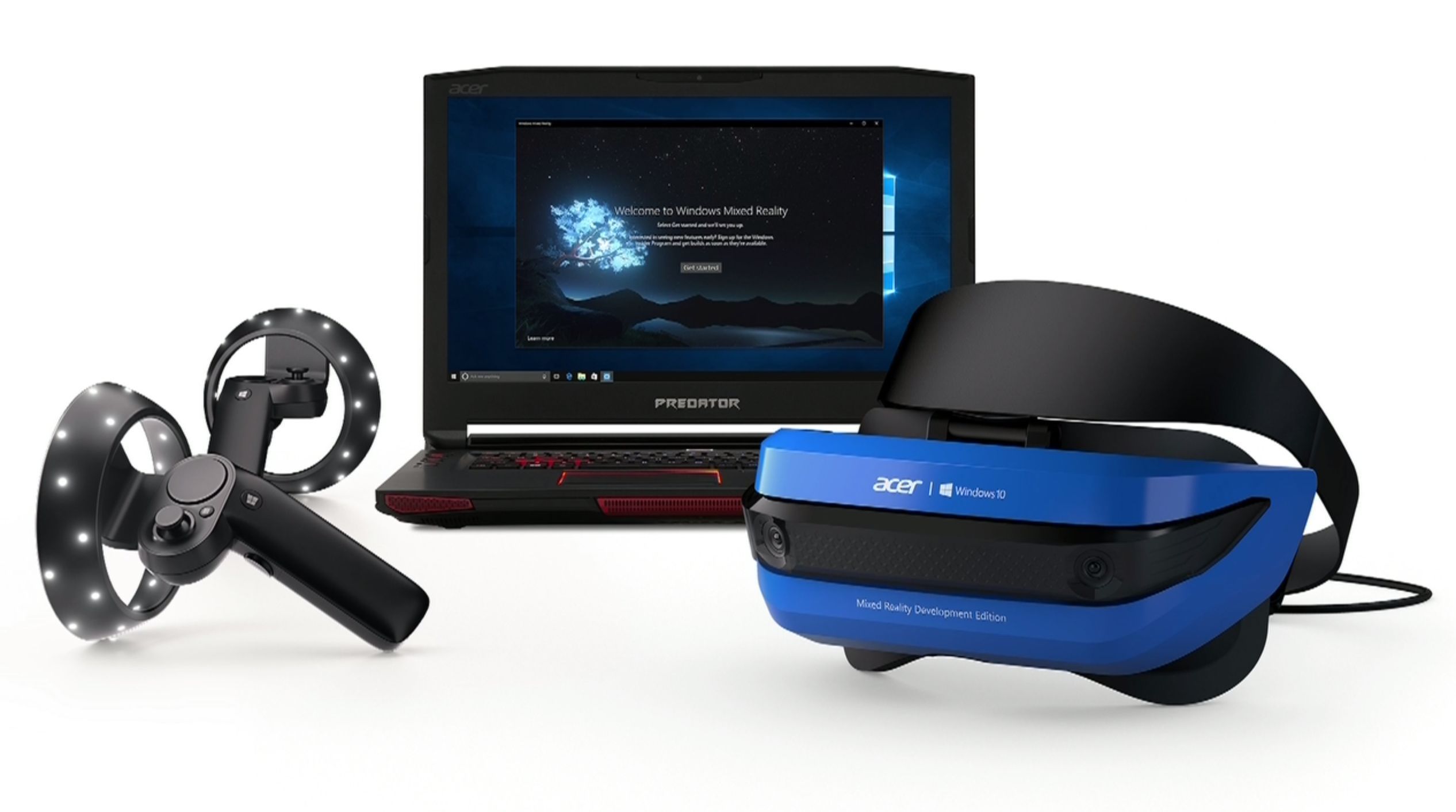 Microsoft
They are really cheap though, which might make you wonder: Is this a good place to get into VR? If it’s your only option, sure, go for it. Just know that you’re signing up for a compromised experience. Windows MR was the first platform to mount cameras on the headset to track both the player’s position and the controllers.
Being first out of the gate has drawbacks though. All of the Windows MR headsets are restricted to two front-facing cameras for tracking. This works fine if you’re holding your hand out where the cameras can see, but the tracking is easily broken by any number of everyday actions: Hand behind your head, hands down at your sides, and so on.
Can you deal with it? Sure, and if it’s your first VR experience you probably won’t know any better. It’s a lesser experience though, and given how much prices have come down for the Oculus Quest and Rift S, the Windows MR headsets no longer seem like as much of a bargain. Hell, the $649 HP Reverb (the top-tier Windows MR headset at the moment) costs more than either the Quest or Rift S, and provides a lesser experience.
How we tested
We used the headsets. And used them. And used them. And used them.
No, seriously. Whenever we review products at PCWorld, we use them for some period of time. I might put a keyboard through its paces for a few weeks, for instance. But I’ve been covering VR since the early days, when all you could buy was the original Oculus Developer Kit.
With such a limited hardware pool, you can trust that I’ve gotten a lot of use out of our VR headsets. The original Vive lasted two years until the Vive Pro came along. That, in turn, stayed on my desk until the Index arrived last year. And the first-gen Oculus Rift had the best run of all, making the trip in and out of my closet fairly regularly from 2016 until the Quest and Rift S released last year—and on the day I finally retired my original Rift, I celebrated, because I no longer needed to use four different USB ports for a single VR headset.
Point being, I’ve put these headsets through their paces and feel confident speaking to the pros and cons of each, be it comfort, optics, the controllers, or even just the price.
All of our VR reviews
Want to delve into more detail? Check out the list of reviews below, where we go more in-depth on the products above, and a few more besides. We’ll keep updating this list on a regular basis (meaning whenever there are new headsets to cover) so be sure to check back in and see what’s going on with VR.