Nvidia GeForce GTX 1080 Ti release date, news and rumors

Update: Nvidia has launched a website with even more clues that suggest the reveal of the GTX 1080 Ti will happen on February 28.

It’s very likely that Nvidia will soon launch the GTX 1080 Ti graphics card, a powerful follow-up to last year’s GTX 1080.

It’s expected to boast even more power to push cutting-edge gaming graphics in native 4K resolution, and while it’s likely to be based on the same Pascal GPU architecture as the GTX 1080, it should still be a decent upgrade over the older (yet still very powerful) GPU.

We’re assuming that Nvidia continues its pattern of releasing a mainline GPU series (along with an incredibly powerful Titan variant) one year, then following up with a more powerful Ti variant the next year.

So, if you’re looking forward to a GPU that’s more powerful than the GTX 1080, and more affordable than the Titan X, then read on to find out all the news, rumors and release date information we know so far about the Nvidia GeForce GTX 1080 Ti.

Cut to the chase

  • What is it? The latest addition to Nvidia’s top of the range graphics cards
  • When’s it out? Recent rumors suggest late March 2017
  • What will it cost? Quite a bit, probably over $600 (£500, AU$800)

Nvidia GTX 1080 Ti release date

Hottest leaks:

  • Almost certain to be announced on February 28
  • Rumors point to late March release

A recent tweet by Nvidia’s UK Twitter account has all but confirmed the reveal of the GTX 1080 Ti at the event on February 28, with the link pointing to a website with a countdown clock to that date.

It also states ‘It’s almost Time’ – Nvidia’s emphasis which is a pretty big clue that the 1080 Ti will make an appearance there.

Going by previous release schedules we expect Nvidia to unveil the GTX 1080 Ti in the first half of 2017, and recent rumors appear to back this up.

Nvidia has sent out invitations for a press event in San Francisco on February 28, promising a showcase of ‘awesome’ PC gaming hardware – so it’s very possible that this is the date when Nvidia will reveal the GTX 1080 Ti.

The timing of this coincides with the Game Developers Conference (GDC), also held in San Francisco, and AMD is likely to announce its rival graphics cards using the Vega architecture, so Nvidia may be looking to steal some of AMD’s thunder.

Another leak from a Finnish website IO-Tech again suggests a reveal on February 28, and a possible release date of March.

There have also been rumours that the GTX 1080 Ti will make an appearance at PAX East in Boston a few weeks later, on March 10.

Nvidia GTX 1080 Ti price

Hottest leaks:

  • Between $600 and $1,200 (£500 and £1,100, AU$800 and $1,500)

There haven’t been a huge amount of leaks or rumors about the price of the GTX 1080 Ti so far, but that won’t stop us speculating!

We can actually use a bit of educated guesswork to try and figure out the likely price tag of the GTX 1080 Ti. The card is probably going to sit between the GTX 1080 and the Titan X in terms power, so it’s likely the price will be somewhere between those two cards – so between $600 and $1,200 (£500 and £1,100, AU$800 and AU$1,500)

That’s quite a wide price range, but going by previous ‘Ti’ releases we can’t see it being as cheap as the GTX 1080 or as expensive as the Titan X, so we’d say around the $850 (£700, AU$1,100) mark is probable. Sadly, it’s very likely that this is going to be an expensive graphics card.

Nvidia GTX 1080 Ti specs

Hottest leaks:

  • 10GB GDDR5 memory
  • 1503MHz base clock
  • 3,328 CUDA cores

Seeing what Nvidia has up its sleeve when it comes to its latest all-powerful graphics card is always exciting.

Rumors of the Nvidia GTX 1080 Ti specifications began swirling last year, with Videocardz.com reporting on a shipping listing for an unnamed graphics card going by the identity PG611 SKU 10, with the PG611 board being equipped with Nvidia’s GP102 GPU, which is also used by the Titan X. 

It also states that the card has 10GB of GDDR memory. That’s a hefty amount, and more than the GTX 1080’s 8GB, although less than the 12GB that comes with the Titan X. 

According to the leak, the 1080 Ti will supposedly have a base clock of 1503MHz (with a boost to 1623MHz) and 3,328 CUDA cores (not much less in comparison to the Titan X’s 3,584 cores, and more than the GTX 1080’s 2,560). 

It’s likely that whatever the spec, Nivida will be looking to make 4K resolution at 60fps (frames per second) on a single GTX 1080 Ti a reality, so we can rest assured that this will be a mightily powerful GPU.

We have also seen leaks that suggest 12GB of GDDR memory. While this would be nice, we have a feeling Nvidia is more likely to go with 10GB to differentiate between the 1080 Ti and the Titan X.

Nvidia GTX 1080 Ti: what we want to see

As we mentioned above, being able to run the latest and greatest games at 3840 × 2160 (4K) resolutions at a rock-steady 60fps on a single card is a very exciting prospect, so we want to see the GTX 1080 Ti being capable of that.

While we’re bracing ourselves for a steep price tag, we can still hope that it will be towards the lower end of our estimates.

Overall, we’d love to see a graphics card that radically pushes gaming graphics and effects forwards, and offers a decent upgrade over the already impressive GTX 1080. 

Will the GTX 1080 Ti manage that, or will we have to wait until next year for the GTX 1100 series? Only time will tell.

Go to Source

Powered by WPeMatico

Amazon resists Echo murder evidence call

Amazon is continuing to resist efforts by prosecutors in a US murder case to obtain recordings from one of its Echo smart speakers.

In its first formal legal response to the request for audio recordings to be handed over, Amazon said prosecutors had failed to establish it was necessary.

It said that it had to weigh customer privacy against such requests.

Prosecutors argue that the data could throw light on what happened.

Police want any information from the Echo that may be on Amazon’s servers on the night of Victor Collins’ death.

Privacy implications

Mr Collins was found floating face up in a friend’s hot tub in November 2015. The friend, James Andrew Bates, has pleaded not guilty to first-degree murder.

The suspect called the Bentonville, Arkansas police department to say he had found the body.

According to court records, one of the deceased’s eyes and his lips appeared to be swollen and suspected blood spots were found around the rim of the hot tub.

Detectives said they learned that music had been streamed to the back patio at the time of death, which they said may have been controlled via the Echo’s smart assistant Alexa.

Lawyers for Amazon filed a motion last week asking a judge to throw out requests for Echo data to be handed over: “Given the important First Amendment and privacy implications at stake, the warrant should be quashed unless the Court finds that the State has met its heightened burden for compelled production of such materials,” its court filings read.

And, in a statement to Associated Press, the firm added: “Amazon will not release customer information without a valid and binding legal demand properly served on us. Amazon objects to overbroad or otherwise inappropriate demands as a matter of course,” the company said in a statement.

Early hours

The “always on” Echo speaker makes recordings of audio it hears from a fraction of a second before it detects a wake word – either Alexa or Amazon – until it judges the command to be over.

This audio is then transmitted to Amazon’s computer servers, which interpret the request and tell it how to respond.

Although no recordings are meant to be made at other times, the device often becomes activated when it misinterprets speech as being its wake command.

Any captured audio might therefore have identified who was active in the early hours of the morning when the alleged murder is thought to have taken place, as well as what was said. Mr Bates claims to have been asleep at the time.

In December 2016, Amazon was issued with two search warrants but refused to share information sent by the smart device to its servers.

Go to Source

Powered by WPeMatico

Nvidia virtually confirms GTX 1080 Ti launch date

Rumors that Nvidia is about to unveil its powerful GTX 1080 Ti graphics card have been swirling, with many suggesting that an event held in San Francisco on February 28 by the GPU maker would see it officially announced – and it looks like the company may have accidentally spilled the beans early. 

In a bid to drum up more hype for the event (if any more was needed), Nvidia’s UK Twitter account tweeted a link with the words ‘It’s almost Time. #UltimateGeForce’. 

As if bolding the ‘Ti’ in ‘TIME’ wasn’t enough of a clue, people who visited the website and viewed the page source saw that the video was labelled ‘GTX1080Ti_countdown’. 

This has since been changed, but the cat appears to be out of the bag. So, has Nvidia spoiled its own surprise? Maybe not, as the emphasis on ‘Ti’ in ‘Time’ all but confirmed it anyway. We’re attending the event on February 28, so we’ll update you with any more breaking news on what Nvidia has in store.

Go to Source

Powered by WPeMatico

The next 'world's fastest' SD card belongs to Sony

If you take any serious amount of photos in RAW format or shoot lots of video footage at, say, 4K resolution, then you need a speedy SD card. Being a kingpin of the memory business for a long time, Sony knows this better than most, and therefore has unveiled the “world’s fastest” SD card: the SF-G Series.

(Read: that is, until a rival comes along and one-ups Sony in a matter of months. It never ends, really.)

Sony’s latest SD cards, aimed at media professionals (natch), boast write speeds of 299 MB/s – that’s megabytes per second, not megabits – and read speeds of 300 MB/s. (The next fastest SD card to date belongs to SanDisk with its 260 MB/s-writing Extreme Pro series.)

The firm chalks up this arguably massive increase to “unique firmware,” and … that’s it.

While Sony is keeping mum on exactly how it crafted the speediest SD card yet, it has released a bunch more qualifying information you should know before picking up one of these bad boys. For starters, make sure your camera(s) and other hardware support cards rocking the UHS (Ultra High Speed) II classification.

Second, Sony is releasing three versions of the card: a 32GB SDHC model as well as 64GB and 128GB SDXC models. And, finally, Sony will also release a compatible, high-speed SD card reader, the MRW-S1, with a USB 3.1 interface supporting UHS II for faster PC transfers.

Sony has yet to release pricing information – though, knowing Sony, expect to pay a considerable sum for this kind of speed when the cards launch this spring. Also, not to look a gift horse in the mouth, but could we use some more capacious cards?

Go to Source

Powered by WPeMatico

10 best gaming laptops 2017: top gaming notebook reviews

Update: For an affordable machine that handles gaming as well as the occasional coffee shop study session, we’ve added the Dell Inspiron 15 Gaming at number 7 on our list. Read on to find out why Dell’s Alienware-less gaming laptop is one of the best!

You want a powerful gaming computer, right? You could save some money and build a rigorous machine that can handle any game at max settings, outperforming the latest consoles at 4K resolution and 60 frames per second (fps). But maybe you tremble at the thought of learning how to assemble a PC, not to mention the fact that a desktop tower is far from portable.

In that case, a gaming laptop is the perfect fit. You don’t have to replace parts individually when one is acting up; in fact, you don’t even have to buy a monitor, mouse, keyboard or even a webcam. Your entire gaming setup is immediately is unified as a single device, free to travel wherever you do.

For a decent gaming notebook, you’re looking at an expenditure of around $1,000 (around £800, AU$1,400) minimum. To experience the best PC games at the highest resolutions and frame rates, you can expect to fork over significantly more. That’s assuming, though, that the games are optimized for the hardware of your choosing.

In this article, we’ve delivered our impressions on the 10 best gaming laptops spanning various brands and budgets. These are the best gaming laptops you can buy in 2017. Not one is perfect, but each entry on this tidily upheld list is high-specced and ready to conquer the hell out of your crowded Steam library.

Best gaming laptops

1. Asus ROG Strix GL502

It’s hard not to love a gaming laptop this good

CPU: Intel Core i7 | Graphics: Nvidia GeForce GTX 1060 – 1070 | RAM: 16GB DDR4 | Screen: 15.6-inch full HD 1,920 x 1,080 IPS | Storage: 128GB – 256GB SSD, 1TB HDD

Rocks Full HD gaming
Deliciously vibrant screen
Middling battery life

The Asus Strix GL502 may not boast the most innovative design, swapping out the usual black and red color scheme for one that makes it feel like Halloween year-round. But, it’s undoubtedly one of the best when it comes to gaming in 1080p. In fact, we were able to crank the settings all the way up in Overwatch without taking a hit below 60fps. The battery life is janky, sure, but the screen, performance and onboard sound system more than make up for it.

Read the full review: Asus ROG Strix GL502

best gaming laptop

2. Razer Blade

CPU: 2.6GHz Intel Core i7-6700HQ | Graphics: Nvidia GeForce GTX 1060 (6GB GDDR5 VRAM) | RAM: 16GB | Screen: 14-inch FHD (1,920 x 1,080) – QHD+ (3,200 x 1,800) IGZO (LED backlit, multi-touch) | Storage: 256GB – 1TB PCIe SSD

Impressive battery life
Thunderbolt 3 a smart add
Fans whir loudly under load
Limited upgrade options

For many gamers, Ultrabook is a four-letter word, but it doesn’t have to be. The first time you get your hands on a Razer Blade, you’ll be looking at a battery life of 3 hours and 35 minutes in-game (or six hours of non-stop video). While you could argue it does skimp as far as graphics are concerned, with the help of a Razer Core external GPU enclosure, you can strap an Nvidia Titan X inside if you want.

Read the full review: Razer Blade

3. Alienware 13 R3

Gawk at the first-ever OLED gaming laptop

CPU: Intel Core i5 – i7 | Graphics: Nvidia GeForce GTX 1060 | RAM: 8GB – 16GB DDR4 | Screen: 13.3-inch HD 1,366 x 768 TN – QHD 2,560 x 1440 OLED touchscreen | Storage: 180GB – 512GB SSD

Gorgeous OLED screen
Improved hinge-forward design
Unexpectedly dense
Short battery life

Unlike most laptops its size, the Alienware 13 R3 bears a hinge-forward design. By moving the heatsinks usually located beneath the keyboard to a distinct bulge that projects outward behind the screen, it allows for a thinner, 0.81-inch (0.22cm) chassis. Unfortunately, this means you won’t find many 13-inch laptop bags that will actually suit the Alienware 13 R3; rather you’ll likely have to opt for a 15-inch carrier. The real draw, however, isn’t the Alienware 13 R3’s protruding appendage or even its impressive quad-core, H-class CPU. While you may be tempted by the inclusion of a full-size Nvidia GeForce GTX 1060, it’s the OLED touch display that caught our attention. The flavorful color gamut puts practically every other laptop on the market to shame.

Read the full review: Alienware 13 R3

best gaming laptop

4. Razer Blade Pro

Finally, a desktop replacement with portability in mind

CPU: Intel Core i7 | Graphics: Nvidia GeForce GTX 1080 (8GB GDDR5) | RAM: 32GB | Screen: 17.3-inch, UHD (3,840 x 2,160) IGZO touchscreen with G-Sync | Storage: 512GB – 2TB PCIe SSD

Starboard trackpad placement
A desktop experience you can finally carry
Off-putting price
Less than 5 hours of battery life

At long last, Razer has introduced a laptop that can not only replace your desktop, but do so without packing on more weight than most large laptops. It’s expensive, yes – it certainly won’t save you money when compared to building your own PC. On the other hand, it measures in at only 0.88-inches thick with an onboard 17-inch, 4K multi-touch display and a built-in Wi-Fi card. If that’s not enough to sell you on it already, the Razer Blade Pro also introduces the company’s Ultra-Low-Profile Mechanical switches to a notebook for the first time ever. These keys bear an appearance similar to your run-of-the-mill chiclet keyboards, but press down on them yourself and you’ll feel (and hear) the authentic click of a mechanical keyswitch. It’s an experience bettered only by its unusual trackpad placement, which feels so natural for gaming that you’ll wonder why it wasn’t there to begin with.

Read the full review: Razer Blade Pro

5. Gigabyte Aero 14

An Ultrabook that’s first-rate in performance and value

CPU: Intel Core i7 | Graphics: Nvidia GeForce GTX 1060 (6GB GDDR5) | RAM: 16GB – 32GB | Screen: 14-inch, QHD 2,560 x 1,440 anti-glare IPS | Storage: 512GB – 1TB SSD

Lightweight and thin design
Competitively priced
Battery life under-delivers
Loaded with bloatware

Donning a 7th-generation Intel Core i7 processor, Nvidia Pascal-series GPU and a screen resolution that soars above 1080p, this laptop is more affordable than a comparably specced Razer Blade or Alienware 13 R3. At the same time, it neglects to compromise in terms of portability and performance. This is a laptop, for instance, that weighs a mere 4.17 pounds (1.89kg) and measures in at 0.78 inches thin, undeniably a feat for a gaming machine. Factor in the 3 hour and 38 minute PCMark 8 battery test and 190-degree hinge, and it’s easy to see why the Gigabyte Aero 14 made the cut.

Read the full review: Gigabyte Aero 14

6. Acer Predator 17 X

Proof the GTX 980 is far from dead

CPU: Intel Core i7 | Graphics: Nvidia GeForce GTX 980 | RAM: 32GB DDR4 | Storage: 1TB HDD, 512GB SSD

Loaded to the max with features
Relatively quiet cooling fans
High price for last-gen GPU
Extremely long battery recharge time

The Predator 17 X isn’t the kind of laptop you would take to a coffee shop on a Tuesday afternoon to catch up on assignments. Unless you don’t mind lugging around a bulky power brick and a 10.03-pound (4.67kg) computer, this is a notebook best left at home. The Predator 17 X is, however, one of the most well-rounded gaming laptops. A desktop-class Nvidia GeForce GTX 980, for instance, is built into the base of the machine, making it (just barely) capable of gaming in 4K. This is a smart move considering that, if you shell out a bit more cash over the base model, the 17 X boasts an Ultra HD display, complete with G-Sync functionality. Paired with more than enough ports to get the job done, the Acer Predator 17 X is well worth the steep asking price, even if it does take three-and-a-half hours to charge.

Read the full review: Acer Predator 17 X

7. Dell Inspiron 15 Gaming

This gaming laptop won’t leave you penniless

CPU: Intel Core i5 – i7 | Graphics: Nvidia GeForce GTX 1050 – 1050 Ti | RAM: 8GB – 16GB | Screen: 15.6-inch, FHD 1,920 x 1,080 – UHD 3,840 x 2,160 anti-glare LED backlit | Storage: 1TB SSHD 8GB – 1TB HDD, 128GB SSD

Stellar battery life
Ports for days
Trackpad is touchy
Screen is lacking

In a world full of overpriced gaming laptops with internals that overcompensate for their underqualified screen resolutions and short-lived batteries, the Dell Inspiron 15 Gaming is a breath of fresh air. Ditching the Alienware moniker for something a little more mainstream, Dell has crafted yet another gaming PC masked as a productivity machine. Following in the footsteps of the Dell XPS Tower Special Edition, the Inspiron 15 is a gaming computer you wouldn’t be embarrassed to use in public. From the outside looking in, the Dell Inspiron 15 Gaming is a class act. Better yet, it’s relatively powerful, long-lasting and, come to think of it, pretty damn affordable too.

best gaming laptops

8. HP Omen 17

A premium desktop replacement sans the premium cost

CPU: 6th gen Intel Core i7 | Graphics: Nvidia GeForce GTX 1070 (8GB GDDR5); Intel HD Graphics 530 | RAM: 16GB DDR4 | Screen: 17.3-inch 4K (3,840 x 2,160) IPS with G-Sync | Storage: 1TB – 2TB HDD, 128GB SSD

Affordable price
4K, G-Sync Display
Plastic-y build
Large physical size

Like the GameCube of laptops, the HP Omen 17 has the build quality of a children’s toy. However, when you see what it can do, you’ll wonder why it didn’t cost more. At 7 pounds, you’ll have to forgive the weight of the HP Omen 17 if you want to benefit from its 17-inch Quad-HD display. Of course, although the GTX 1070 is more of a 1440p performer than a 4K one, you can still expect a consistent 30 fps in games like The Division at the highest graphical settings. Overall, the HP Omen 17 is HP’s Gigabyte P57X equivalent, but with Bang & Olufsen speakers that might tip you over the edge.

Read the full review: HP Omen 17

9. Aorus X5 v6

High power and a low profile with few concessions

CPU: Intel Core i7 | Graphics: Nvidia GeForce GTX 1070 (8GB GDDR5) | RAM: 8GB – 16GB | Screen: 15.6-inch, FHD 1,920 x 1,080 – WQHD+ 2,880 x 1,620 IPS | Storage: 1TB HDD; 256GB SSD

Powerful performance
Slim design
Noisy fans
Build quality issues

You may not be as familiar with Aorus as you are with many of the other contenders on this list. That said, the company makes a damn fine gaming laptop with relatively subdued designs to boot. The Aurorus X5 v6 in particular comes in an all-black finish with a GTX 1070 powerhouse under the hood. Connected to a 144Hz external monitor, the Aorus X5 v6 can handle Overwatch at up to 120 fps on Ultra. When it’s not wowing you with its internal capabilities, it’s doing so with its 15-inch, 3K resolution display. Though its fans make it sound like a helicopter about to depart, and the build quality isn’t exactly ideal, the Aorus X5 v6 averts gaudy color schemes in favor of sheer horsepower.

Read the full review: Aorus X5 v6

Best Gaming Laptops

10. Origin EON17-X

With great power over price comes great responsibility

CPU: Intel Core i5 – i7 | Graphics: Nvidia GeForce GTX 1060 – 1080 | RAM: 8GB – 64GB | Screen: 17.3-inch, FHD (1,920 x 1,080) – QFHD (3,840 x 2,160) Matte Display with G-Sync | Storage: 120GB – 2TB SSD, 500GB – 2TB HDD, 1TB – 2TB SSHD

Keyboard offers deep travel
4K media mastery
Annoying trackpad
Tiny fingerprint reader

With the introduction of the Nvidia’s Pascal architecture, we’ve finally seen laptops like the Razer Blade Pro take on doubles lives as desktop PCs. The Origin EON17-X follows suit with a 4K display and a GPU that can handle the heat, all for a significantly lower starting cost. It doesn’t come with the dead silent mechanical keyboard, but it flaunts one that is tactile nonetheless. While it’s undoubtedly the most powerful laptop we’ve used to date, it’s also among the most expensive. Considering the battery life maxes out at a dastardly 1 hour and 54 minutes, according to our own movie test. That’s a far cry from the Razer Blade Pro, which managed close to 4 hours. Otherwise, it’s perfectly outfitted for that place on your desk where your desktop would be – if you had the space.

Read the full review: Origin EON17-X

  • Only interested in light gaming? Try a Surface Book on for size

Gabe Carey has also contributed to this article

Go to Source

Powered by WPeMatico

15 best PC gaming headsets 2017

Update: We’re constantly updating our list of the best gaming headsets, so make sure you check back here regularly to find our expert opinion on the latest and greatest headsets.

Having a great set of gaming headphones can revolutionise your gaming experience. Not does high quality sound quality make you feel like you’re part of the action, 7.1 surround sound can fully immerse you and make you feel like you’re really in the game.

Surround sound can also help improve your scores, as you’ll be able to hear enemies sneak up behind you.

Without the best gaming headset, you’re depriving yourself of full-on immersion from every angle – after all, who says you need VR for 360-degree fun? Pick the right pair of headphones outfitted with a clear quality mic and you’ll immediately notice a difference in the way you experience games.

Whether you need a USB or 3.5mm headset, a surround sound or stereo pair, or simply one to communicate with friends online, we’ve picked out the very best PC gaming headsets for your needs.

Though we haven’t had the chance to fully review every headset on this list, rest assured that each has been tested comprehensively prior to its consideration.

1. Astro A50 Wireless

The best all-round headset just got better

Interface: Wireless | Features: Dolby Digital 7.1 Surround Sound; Works with PS4, Xbox One, Xbox 360, PS3, PC, and mobile; Astro Audio; 5.8GHz wireless tech with MixAmp; 6.0mm uni-directional noise cancelling mic; USB charging with base station

Full-bodied Dolby 7.1 Surround sound
Supremely comfortable
Finnicky charging cradle

We called the original Astro A50 a “game-changing, experience-enhancing headset”, and thankfully its wireless successor follows the “ain’t broke, don’t fix” rule. Astro’s latest headset does what it says on the tin and adds wireless connectivity to an already stellar package. Though not the cheapest headset on the block, the Astro A50 Wireless has transferred amp controls from its predecessor’s cable right into the headcups themselves, giving you the ability to balance in-game audio and voice chat on-the-fly.

Add to that the A50’s solid aluminum construction, effective noise-cancelling microphone, booming bass and impressive mid-range sounds, and you have one headset that’s ready to rock on PC, PS4, and Xbox One. It’s also suitable for using with the HTC Vive and other VR headsets thanks to the accommodating shape of the headband. We’ve found that few headsets can rival the A50’s comfort’s plush ear cups, which are large enough to give you a realistic sense of sound coming from all directions.

Siberia 840

2. SteelSeries Siberia 840

A fantastic all-rounder that’s hugely comfortable

Interface: Wireless or wired | Features: Closed back earcups, Dolby virtual 7.1 surround sound, Retractable directional mic with mute indicating light, Two hot-swappable Li-Ion batteries, Sound share audio recording, Click wheel, Memory-foam ear cushions, Works with Xbox 360, PS3/4, PC/Mac, Apple TV/Roku, Home entertainment and mobile devices

Dolby 7.1 surround sound
Comfortable

Sometimes you’re prepared to pay a premium for a PC gaming accessory that does the lot, and in the headset category that’s the Siberia 840. Following on from the already impressive Siberia 800 (and the H Wireless before that from 2014), the upgraded Sibera 840 now works with Bluetooth and is lag-free within games. It also supports SteelSeries Engine 3 – a gorgeous and user-friendly app that lets you manage and tweak every element of the Siberia 840 – from profiles to equalizer settings and what to show on the OLED display on the side of the accompanying base unit.

All of that is, of course, secondary to the Siberia 840’s sound qualities which are nothing less than sublime. Activating Dolby 7.1 surround sound is like dropping you into the game. Enemies’ footsteps can be picked out across a room including behind you, leading to some heart-in-mouth moments in shooters like DOOM.

3. Asus ROG Centurion 7.1

10 drivers, 7.1 channels and one impeccable headset

Interface: Wired (USB) | Features: 10-driver 7.1 surround sound, dual-USB amplifier, Sonic Software compatibility, HDMI passthrough, amplifier with audio profile and channel volume controls, unidirectional microphone

Excellent spatial sound
Speaker passthrough
Can only be used with its amp
Heavy and bulky

Who cares about style when it comes to gaming headsets? Certainly not Asus. Neglecting all the unwritten rules of fashion, the ROG Centurion 7.1 is a spectacle to behold, both for its garish looks and unruly knack for omitting crystal clear sound waves. It may be a living hellscape to set up, requiring that a pair of USB cables be connected to an amplifier at all times, but that’s not to say it doesn’t offer plenty of room for expansion. 

In fact, the Asus ROG Centurion 7.1 not only bolsters full-fledged surround sound passthrough for an external set of speakers, but the onboard amp controls grant you complete control over the audio profiles and channel volumes being outputted. You can even take advantage of Asus’s own Sonic Studio software package, which gives you even more dominance over the headset’s functions. There’s a steep learning curve, but for those who don’t mind, this headset is a mighty surround sound offering.

Read the full review: Asus ROG Centurion 7.1 headset

V MODA

4. V-MODA Crossfade Wireless

Stylish with powerful bass-driven tones

Interface: Wireless or wired (USB) | Features: Bluetooth connectivity, built-in microphone (Boom Microphone available for gamers), Lithium-ion battery with up to 12 hours of continuous music, Dual-diaphragm 50mm driver, Metal construction with leather, Military-level MID-STD-810 tested

Huge, eardrum-filling sound
Comfortable padded cups
Divisive design
Don’t fold

If you’re more interested in the sounds coming out of your gaming headset, rather than glowing LEDs, macro keys and other nonessential extras, then the V-MODA Crossfade Wireless is the headset for you. These stylish cans are a treat for the ears, emitting booming sound that’s bass-heavy with fantastically crisp treble at the other end. Whether you’re being rocked by explosions in Battlefield or can hear the roar of the crowd in Fifa, they bring games to life and are equally suited to listening to music; You’ll be able to pick out parts of your favorite tracks that you never previously thought existed.

Stepping out of the soundscape for a moment, the V-MODA Crossfade Wireless feature comfortable memory foam ear cups that don’t irritate the ears even after hours of use, and you’ll get around 12 hours out of its battery life when connected via Bluetooth. This headset’s rugged build quality, funky travel case and optional USB connectivity add up to make it one of the best headsets on the market.

Read the full review: V-MODA Crossfade Wireless

5. Turtle Beach 350 Stealth VR

The best gaming headset for virtual reality

Interface: Wired (3.5mm) | Features: Battery-powered amplification (30 hours on a single charge), Variable bass boost, Full-range audio, Mic monitoring, Removable noise-cancelling microphone, Ergonomic VR design. Swappable cable system

Ergonomic design suits VR headsets
Battery amplification provides full-bodied sound
Mic monitoring lets you hear yourself
Feel flimsier than more expensive headsets
No surround sound

With VR headsets like the HTC Vive and Oculus Rift making their way into PC gamers’ rooms, specially-designed audio headsets for virtual reality were bound to follow. The Turtle Beach 350 Stealth VR is one of the most flexible out there, featuring a generous amount of adjustability thanks to its sturdy headband which can fit over the top of VR headsets worn on even the biggest heads. Sure enough, the 350 Stealth is designed for practicality rather than sharp looks. Its black-and-white color scheme isn’t the most exciting design out there, but an abundance of features makes up for that. There’s mic monitoring, which allows you to hear your own voice inside the headset, bass boost for booming lows, a detachable noise-cancelling headphone mic, and a groove in the ear cups that lets you tuck the audio cable out of the way. While it’s perfectly suitable for owners of PC-based VR headsets, it’s quite literally a great fit for PSVR gamers too.

6. SteelSeries Arctis

High performance with a low profile

Interface: Wireless or wired (3.5mm) | Features: 2.4GHz wireless technology (Arctis 7 only); 15-hour battery; built-in digital audio control; Virtual 7.1 Surround Sound; Steelseries Engine software, Compatible with PC, Mac PS4, Xbox One, smartphones, tablets and VR

Sterling bass and treble quality
Professional design
Ugly suspension headband

Unlike some of its competitors, SteelSeries stresses subtlety in its headset designs. The Arctis continues this trend by flaunting sound quality and comfort over gaudy appearances. 

When you pop an Arctis on your head, the goal is for your audience to see a professional environment rather than, say, a Dorito stain on your chair. The customizable lighting, however, gives you plenty of wiggle room, though, if the monochrome look isn’t your thing.

The SteelSeries Arctis comes in three distinct flavors: Arctis 3, Arctis 5 and Arctis 7, each one more expensive than the last. The Arctis 3 is pretty analog protocol while the 5 ships with an external digital-to-analog converter (DAC) and the Arctis 7 is wireless with 2.4GHz connectivity. Each model comes with digital audio control built-in, with an app available for those looking to take this one step further.

The only drawback, then, is a less-than-attractive suspension headband.

Razer ManO War

7. Razer ManO’War

Surround sound without the fuss

Interface: Wireless | Features: Software-based 7.1 surround sound, Earcup-mounted controls, Chroma RGB multi-color lighting, 14-meter range (using an extender, 12 meters without)

Great surround sound
Easy to set up
Multi-color lighting
Slightly bulky
No wired option

Quick and easy to setup using an inconspicuous wireless USB receiver that stores inside the headset for transportation, the Razer ManO’War is a user-friendly unit that’s primed for surround-sound gaming. Sure, it’s a little chunkier than most other headsets, but two soft leatherette ear cups make it comfortable to wear for extended periods. They’re easy on the eye too thanks to customizable Chroma RGB backlighting configured through Razer’s Synapse software.

Though delivered through software, the ManO’War’s 7.1 channel virtual surround sound does a fine job of ramping up immersion in-game. Doom’s Imps are no longer somewhere around you – they’re breathing down your neck. The ManO’War’s range can reach up to 14 meters using the supplied USB extender, and its battery life is capable of stretching to just as many hours.

As a more affordable alternative, Razer has launched the ManO’War 7.1 Wired Gaming Headset. It comes with a USB digital-to-analog convertor (CAV) that provides superb surround sound and the same eye-catching design as the wireless edition (only without the RGB lighting).

Read the full review: Razer ManO’War

Best gaming headset

8. HyperX Cloud Stinger

Great sound at a price for everyone

Interface: 3.5mm analog wired | Features: Closed back earcups, Swiveling noise-cancellation microphone, Onboard volume slider, Multi-platform compatibility, Memory foam earcups

Lightweight
Excellent ergonomics
Unremovable microphone
Light on bass

Arguably one of the most affordable gaming headsets available today, the HyperX Cloud Stinger is designed to give players eSports quality audio at a bargain. While there isn’t much to write home about with the red on black plastic design of the headset, the stereo sound is superb. It also feels comfortable to wear for extended play sessions thanks to a set of memory foam earcups. Although this isn’t the ultimate gaming headset, it’s a great starting point if you’re trying to game on a budget.

9. Sennheiser GSP 350

Stellar Sennheiser audio quality for less

Interface: 3.5mm and USB (for 7.1 surround) | Features: Closed acoustic earcups, Memory foam ear pads, Right ear cup volume control, 7.1 Dolby Surround Sound, Broadcast quality noise-cancelling microphone, Automatic mic mute, Split headband design

Dolby 7.1 Surround Sound
Sturdy build quality
Comfortable memory foam earpads
Dolby surround only works with PC

More affordable than Sennheiser’s flagship PC 373D while still packing an audible punch, the GSP 350 carries over that headset’s stellar 7.1 Dolby Surround Sound and closed ear-cup design. It’s equally a suitable for marathon  gaming sessions thanks to its huge comfortable ear cups, with the right cup once again featuring a volume dial. The headset uses a closed-back design with an adjustable split headband, rather than the PC 373D’s more solid and thicker continuous band. The GSP 350’s noise-cancelling microphone is equally as good and once again mutes when lifted up while blocking out breathing sounds, much to the relief of your in-game team-mates. If you like the look of Sennheiser’s flagship gaming headset but can’t quite stomach its price tag, this one is a little lighter and slightly less solid, but still superior to many of its rivals.

G33 Artemis Spectrum

10. Logitech G933 Artemis Spectrum

A command center on your head

Interface: Wireless or wired (3.5mm) | Features: 7.1 Surround Sound, Cup-mounted G-Keys (macro), Programmable RGB mutli-color lighting

Attractive design
Cup mounted macro keys
Comfortable
Average battery life

Logitech’s flagship gaming headset packs in plenty of bells and whistles, the most useful being its cup-mounted G-keys that provide handy shortcuts to performing actions in-game. In terms of design, The G933 is certainly one of the snazziest headsets around and oozes gamer appeal, and if you’re fed up of round ear-cups on headsets then you’ll appreciate its large and comfortable ear-shaped ones. Logitech has ran a multi-colored lighting strip all the way down the cup, rather than placing a flashing logo on the side, which in our eyes is more appealing than the small glowing areas on Corsair’s and Razer’s flagship headsets. On the negative side, this cuts down battery life to around 10 hours. Turning off the flashing goodness will help you eke out a few more,

Corsair Void RGB

11. Corsair Void RGB

Lights up the room and your ears

Interface: Wireless or wired (USB) | Features: 7.1 software-based surround sound, 2.4GHz wireless, 40-feet wireless range, 16-hour battery life, Mic on indicator, RGB lighting, Corsair CUE software, 50mm neodymium drivers, Noise-cancelling microphone

Well-built
Long wireless range
Surround sound works well
Cloth (rather than leather) ear cups
Microphone isn’t great

If you’re looking for a pair of 7.1 surround sound cans with RGB lighting that won’t break the bank, Corsair’s latest entry should be high up your list. Its excellent 40-meter wireless range means you can go for a wander without your team-mates’ chatter cutting off, and the Void is capable of emitting fist-pumping bass that’s powerful without muddying the mix. You can configure its lighting colors using Corsair’s intuitive software and even make it dance in tandem with the company’s K65 or K70 mechanical keyboards. Unfortunately, there isn’t any way for adjusting the fold-down mic so its clarity often suffers, but it doesn’t put us off what is a solid and affordable option for surround sound gaming.

Cloud Revolver

12. HyperX Cloud Revolver

Affordable and comfortable with punchy bass

Interface: Wired (dual 3.5mm) | Features: 53mm drivers, Ear cup memory foam, Noise cancellation mic, Audio volume and mute controls, Detachable microphone

Good value
Decent build quality
Punchy, bass-driven sound
No surround sound
No headset controls

Here we have a no-frills headset that offers build quality that comes close to pairs that cost almost twice the price. You may have already come across Kingston’s HyperX Cloud Revolver headset. Used by a number of eSports teams, its large interchangeable over-the-ear memory foam cups help block out unwanted noise, and the retractable mic allows clear and distortion-free communication with team-mates.

Despite its affordable nature, the Cloud Revolver is ready to rock. Its 53mm drivers have been tweaked to blast out punchy mid-range tones and pounding bass that’s best described as in-your-face. Subtle they ain’t. There’s no surround sound support or RGB lighting to be found here, and you’ll have to reach for the Cloud Revolver’s braided cable to get to its in-line volume and mic controls. If those factors don’t bother you then this value-focused headset comes highly recommended.

ROG STRIX WIRELESS

13. Asus ROG Strix Wireless

Low-input lag makes these great for gaming

Interface: Wireless | Features: 2.4GHz wireless technology; 900mAh battery; Headset-mounted control buttons; Virtual 7.1 Surround Sound; Sonic Studio software’ Compatible with PC, PS4, Xbox One, smartphones, and tablets.

Great 7.1 surround sound
Soft padded earcups
Bulky plastic design

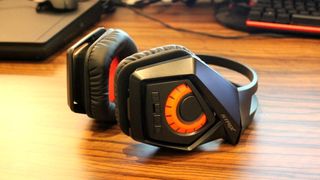
Looking like something straight out of Quake 2, Asus’ Strix 7.1 wireless gaming headset immediately caught our eye thanks to its large black-and-orange ear cups that are decked in a circular pattern resembling an owl’s eye. Those oversized ear cups makes them comfortable to wear for extended periods but there’s no RGB lighting on them, which on the plus side provides up to 10 hours of continuous gameplay using 2.4GHz wireless to connect.

Asus claims that it provides lower latency than Bluetooth, and while it’s difficult to verify that, bullets whizzing past our head in-game synched up pretty well thanks to virtual 7.1 surround sound being blasted into our ears from all directions. Asus’ Sonic Studio software provides an easy method of tweaking sound settings, and we found cranking up the (already sufficient) bass in the app’s equalizer particularly satisfying for both gaming and listening to music.

Turtle Beach

14. Turtle Beach Elite Pro

Like kicking back on your favorite comfy couch

Interface: Wireless or wired (3.5mm) | Features: 3.5mm upstream and downstream jack, 50mm drivers, Memory foam earpads, Glasses relief system, Optional Tournament Audio Controller, Standard microphone included

Comfortable
Tactical Audio Controller
No surround sound
Pricey with TAC

Aimed at PC and console gamers, using Turtle Beach’s Elite Pro feels like sitting down at a command station and gearing up for war. This headset oozes gaming appeal, right down to the subtle orange ruler-type markings on the headset’s automatically adjusting headband. It’s a funky piece of kit that’s reassuringly chunky while remaining supremely comfortable at all times thanks to its gel-infused Aerofit ear cushions. Most importantly, they sound great in the heat of battle. That’s down to Turtle Beach’s 50mm NanoClear drivers, which do an especially great job of bringing you into the heart of the action in shooters.

If you’re particularly hardcore, you might want to shell out for the Tactical Audio Controller. At $199 (around £149) it’s not cheap, but it grants an intuitive and fun of adjusting settings such as the game/chat mix, your own microphone level, in-game sounds, and there’s also a mute button to cut game sound out completely. It also lets you chop and change between four surround modes (Game, Music, Movie and off), which is a lot easier than fiddling around with controls on the headset itself.

15. Cougar Immersa

Powerful sounds and an eye-catching price tag

Interface: Wired | Features: Compatible with PC and consoles, 100mm ear padding, Noise cancelling microphone, 40mm drivers, 100mm extra-large ear pads, Retractable microphone, Leather headband design

Big comfortable ear cups
Powerful bass
Headband feels flimsy

There are an increasing number of PC gaming headsets impressing at the lower end of the price spectrum, including the new Cougar Immersa. Decked in the company’s trademark orange-and-black color scheme, this gaming headset is big, bright and bold. Its massive earcups envelop the ears and are comfortable when worn over long periods. The Immersa’s mid-range and bass tones are punchy and bright, though treble is a little lacking. The retractable microphone is convenient, and online gamers had no trouble hearing what we were saying in Counter Strike: GO. HyperX Cloud Stinger aside, there are few gaming headsets in this price bracket that have impressed us like the Immersa.

Go to Source

Powered by WPeMatico

Apple Park opens in April – new HQ comes complete with sweet Steve Jobs homage

Apple’s futuristic ‘Campus’ HQ will finally open its doors to employees this April, under its new name, ‘Apple Park’.

While there’s no word yet on whether or not it has a T-Rex, it will have a heartfelt homage to former Apple boss Steve Jobs. Jobs, who helped in the early stages of the site’s development, will have the 175-acre campus’s 1,000 seater theater named after him.

The Park, replacing Apple’s current One Infinite Loop base of operations, is fully powered by renewable energy, with its spaceship-like design measuring up at 2.8 million square feet of space.

‘The home of innovation’

“Steve’s vision for Apple stretched far beyond his time with us. He intended Apple Park to be the home of innovation for generations to come,” said Tim Cook, Apple’s CEO. 

“The workspaces and parklands are designed to inspire our team as well as benefit the environment. We’ve achieved one of the most energy-efficient buildings in the world and the campus will run entirely on renewable energy.”

“Steve invested so much of his energy creating and supporting vital, creative environments,” added  Jony Ive, Apple’s chief design officer.  

“We have approached the design, engineering and making of our new campus with the same enthusiasm and design principles that characterize our products.”

If a job at Apple didn’t already seem like a dream, the Apple Park has some great perks or its employees, with a 100,000 square-foot fitness center, apple orchards (obviously) and running paths to explore. 

Go to Source

Powered by WPeMatico