It’s almost time for students to be heading back to school. Even if you’re not going back to school physically, it’s always a good idea to have the best software to do your best work. And if you’re a PC user without Microsoft Office, it’s time to rectify that problem during our Back-to-School sale. Between 7/28 and 8/13, you can get a lifetime license to Microsoft Office Pro 2021 for Windows, plus a free training bundle to help you learn how to master it, for just $34.97. This bundle is rated 5/5 stars by verified purchasers.
Office includes Word, Excel, PowerPoint, Outlook, Teams, OneNote, Publisher, and Access — everything you need to do your best work. For a one-time price, you’ll have the world’s leading office software, plus you’ll get eight courses to help you get the most out of each individual program.
You don’t have to be going back to school to get in on these savings. Between July 28 and August 13, get Microsoft Office Pro 2021 for Windows and more for just $34.97.
Microsoft Office Pro 2021 for Windows: Lifetime License + A FREE Microsoft Training Bundle – $34.97
MySpace launched exactly 20 years ago today – so if you remember the pre-Facebook beast of social networks, it’s time to join us for a celebration of its charms and idiosyncrasies.
So what went wrong? A combination of being acquired by News Corp – who filled MySpace new features and ads – plus the rise of Facebook, meant that the ‘place for friends’ quickly became slightly embarrassing joke. After a relaunch in 2012 that saw it try to be too many things, MySpace went on a slide that ultimately saw it become the niche music website it is today.
(Image credit: 360b / Shutterstock)
But that doesn’t mean we’ve forgotten the site’s early years. Not everyone on the TechRadar team looks back on those early MySpace years fondly, with our US editor in chief Lance Ulanoff recalling that it “it was like peoples’ brains had been turned inside out and whatever didn’t stick, dropped onto the page and was represented as a GIF”.
Many of us do, though, remember picking our Top 8s (the site’s weird ranking system for your friends) and decorating our MySpace pages with as many flashing lights as possible. So here are the five main things we miss about the original social network…
1. It was a place for genuine musical connection
MySpace was the best (and for a while, the only) way to feel close to bands I loved.
The year is 2006. Facebook has launched, but that is for ogling the current miens of historic crushes, shallow and impersonal ‘pokes’ plus the deflection of Scrabble requests from people you’re now glad you never dated in high school.
MySpace is not about silly visages and it isn’t about geographical locations (I was trotting around the world having quite the career as a professional dancer thanks very much, but MySpace wasn’t about me). No, MySpace is a place to look out – at bands expressing themselves on a much deeper level about musical influences, pride at upcoming tour dates and crucially, album launches. In the pre-Twitter era, it felt so personal and real.
(Image credit: MySpace)
I felt like I understood what each of Patrick Watson’s gifted Montreal-based musicians brought to Close to Paradise, the potentially difficult second album which only went and won the 2007 Polaris Music Prize, beating Arcade Fire’s Neon Bible to do so. I celebrated the win in my small London flat, thousands of miles away from the Phoenix Concert Theater in Toronto.
And I think for a while, only MySpace made this possible.
Becky Scarrott, Senior Audio Staff Writer
2. MySpace made me feel like I was popular
Before Tinder, Bumble, Happn, Hinge and all the rest, there was… MySpace? Well, sort of.
When the social network crashed onto our computer screens 20 years ago, smartphones weren’t a thing, so dating apps didn’t exist. There were dating sites, sure, but the late-twenties-me would never have considered signing up for one.
Of course, I didn’t painstakingly craft my MySpace profile with romance in mind, either. Far from it. When MySpace arrived, I was working as a music journalist and it was the platform’s possibilities as a showcase for new talent that most excited me and my colleagues. Arctic Monkeys famously got their big break via demos uploaded to a MySpace fan page, and I spent many hours trawling the site for the next big thing.
(Image credit: Future)
I also spent many hours chatting to people on it when I should have been working – and that was solely because this newfangled social media thing made it possible for a socially awkward individual like me to actually make friends (in a sense).
I had help here: my workmates were all far cooler and more sociable than me, so it was very easy for me to garner huge numbers of Connections simply by piggybacking on their popularity. And in no time at all, I was the king of social media! The popular kid I’d always wanted to be at school! Look, I’ve got 200 friends on MySpace! Take that, school bullies!
The high, for me, was also the low. I got chatting to a friend of a friend of a friend, we hit it off and, somehow, we agreed to go on a date. Obviously this was a bad idea, because chatting to someone online is not the same as talking to them in real life, particularly for a socially awkward individual like me. The date was a disaster and I never tried that again. I still liked pretending I had hundreds of friends, though.
Marc McLaren, UK Editor in Chief
3. It actually taught me to code
MySpace was my first interaction with a social media site. Outside of online chat rooms, like MSN Messenger, it offered a space on the web that you could own – much like a blog page.
I was encouraged to sign-up for it in school by friends and, caving under the pressure, made a profile. Much like Messenger, where it was ‘kewl’ (why did we all type like this?) to use the plugin that showed what music you were listening to, MySpace also had a dedicated music player. It was a space for self expression, which meant that changing the style of your profile page with HTML and CSS became a big part of it.
(Image credit: Codecademy)
This was the early 2000s, when I didn’t know a lot about Web 1.0 or coding, and I wasn’t going to buy a MySpace layout, so I eventually worked out the basic prompts needed to hide my top eight friends as well as to add in some funky widgets that made my comments become visible again using JavaScript or Flash.
I’m probably guilty for all the bugs that were on the site back then – sorry, Tom!
Amelia Schwanke, Senior Editor for Home Entertainment
4. It was my favorite internet echo chamber
Many people, my colleagues included, remember discovering great bands and exciting new music on MySpace. But for me, my memories of MySpace is one of echo chambers and tribalism, albeit with a degree of fondness.
I was 15 years old, deep in a phase of palatable punk-rock, wallet chains and baggy jeans. All my friends were of a similar disposition: skateboarding, playing in local bands, and using MySpace to chat online outside of school. Via the magic of HTML and MySpace’s feature that allowed you to play a song automatically when you visited a page, scrolling through my top friends on MySpace would have assaulted your ears with a variety of alternative classics from Sum 41, Iron Maiden, Green Day, Rage Against the Machine, Korn… you get the picture. A mixed bag of sub-genres you could today throw into a Spotify playlist titled simply ‘rock’.
Our school was split right down the middle: the alternative kids took MySpace, the sporty kids who listened to pop chose Bebo, and never the twain shall meet. Rather than using MySpace as a tool to discover new music, it was a safe space to express our fondness for the music we already knew and loved. I remember MySpace fondly as my first ‘virtual hangout’ space, a village hall tailored to the interests of myself and my friends.
(Image credit: MySpace)
I switched to Facebook after all my friends did the same, and was disappointed at the lack of personality I was able to inject into the look and feel of my Facebook page. Where were my poorly-animated flames? The auto-playing music? Where was Tom?
I didn’t know it then, but that was the start of my experience with the Corporate Internet, a move away from spending my time online with MySpace, HTML and link-surfing through the old Blogosphere, and more time spent in boxes set up by billionaires scraping our data for advertisements. When I remember MySpace, I remember the internet’s halcyon days, the advent of social networking, and sticking it to the man, Jack Black-style. Rock on, dudes.
Matt Evans – Fitness, Wellness and Wearables Editor
5. It was the last age of social media innocence
It’s hard to say exactly when social media became the performative, carefully stage-managed PR campaign that it is today, but MySpace reminds me of the innocent time before mass pile-ons and billionaire acquisitions. It was a bit like discovering your first favorite dive bar, before an inevitable takeover turned it into another sterile chain covered in fake graffiti.
Before TheFacebook.com had escaped Harvard, MySpace was home to the photo albums that the unsuspecting pioneers of the early noughties would later look back on with fondness and, perhaps, more than a little regret.
(Image credit: BBC / Myspace)
A case in point are the accounts and grainy photos from some today’s biggest Premier League soccer players, which have resurfaced to provide some excellent WhatsApp ammunition for their fellow team-mates. The cruise album above from what appears to be soccer player Harry Kane is a particularly fine example.
Still, the good news for anyone who uploaded some slightly embarrassing songs, photos or videos to MySpace before 2015 is that they’ve probably all disappeared – back in 2019, the social networking site blamed a faulty server migration for the permanent loss of 200TB of data from its first decade of existence. Cue a collective sigh of relief from everyone who’d forgotten all about their early MySpace adventures.
Gaming accessory brand 8BitDo is going old school with its first-ever mechanical keyboard sporting a design reminiscent of past Nintendo consoles.
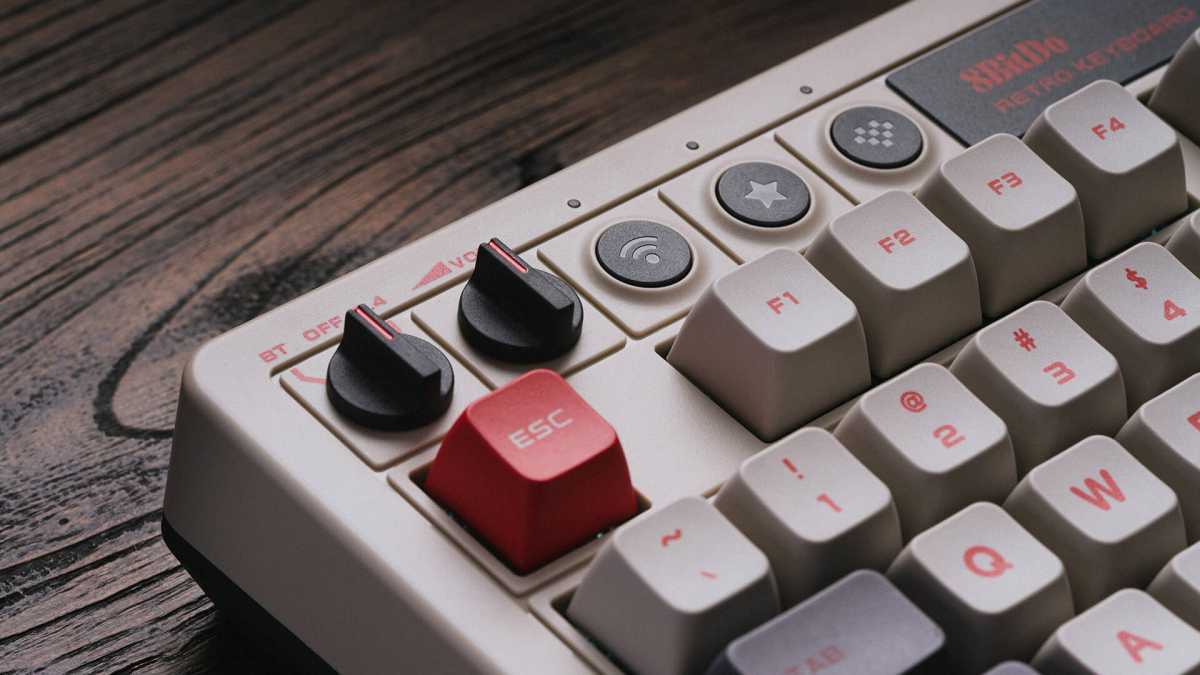
Aptly named the Retro Mechanical Keyboard, it comes in two distinct color schemes: one in black, gray, and red matches the NES, while the other is based on the Famicom – the Japanese rendition of the console. On the latter, the red will have a more rustic shade and white is replacing the gray for a brighter look. The Famicom version even has hiragana on most of the keys. So this particular model can potentially double as a Japanese tutor of sorts, helping students learning the language become more familiar with it.
(Image credit: 8BitDo)
There is more to this device than simply being a pretty keyboard, and it does have some interesting hardware. Starting with the externals, the Retro Keyboard has a tenkeyless layout meaning there’s no number pad on the side. You’ll notice on the bottom are ‘B’ and ‘A’ buttons. These two are programmable, allowing owners to add whatever macro they want to them like Control-C on ‘B’ and Control-P on ‘A’. This can be done through 8BitDo’s Ultimate Software app. Other cool design flourishes include the Power LED light in the top right corner with the analog knobs on the left adding to the vintage 1980s look.
Internal hardware
Internally, the Retro Keyboard is fairly impressive as well. Each of the keys sits on top of Kailh Box V2 White switches. According to the manufacturer, the V2 Whites feature “gold-plated springs,” which, according to the company have anti-corrosion properties, are dustproof and offer “faster rebound” for a smoother typing feel. It is important to mention the switches are hot-swappable so if you want to install your preferred hardware, you do have that option.
The Retro Keyboard allows both a wired connection via USB cable alongside wireless connectivity. For wireless, you have two options: Bluetooth Low Energy or 2.4GHz WiFi. A 2.4GHz adapter does come with the purchase. Battery life is set for “200 use hours with 4 hours [of] charging time”.
Officially, this device is compatible with Windows 10 and above as well as Android 9 and above. However, a company representative told Engadget it will work on Mac, although they didn’t specify an operating system.
Availability
You can pre-order the keyboard right now on either 8BitDo’s website or Amazon for $100 USD. The shipping date is set for September 10. If you do pre-order, you’ll get a pair of programmable Super Buttons.
The Super Buttons are essentially a gigantic version of the ‘B’ and ‘A’ mentioned earlier. These can serve as an extra set of keys for personal macros or maybe as a controller for 2D-style games. There are, after all, a ton of indie titles that adopt side-scrolling action. Pair the buttons with the directional keys and you’ll basically have a giant NES controller.
We reached out to 8BitDo to ask if there are plans to launch the Retro Keyboard outside the United States and for some clarifications on Mac compatibility. This story will be updated at a later time.
There’s nothing I love more than a reasonably priced gaming laptop, especially one with a touchscreen and other features. If you’re in the market for such a laptop, you better stick around. Best Buy’s currently selling the Asus ROG touchscreen gaming laptop for $1,199.99, which is a savings of $800 (!!!). Not only are you getting a 1600p touchscreen that swings around 360 degrees, but also an Nvidia GeForce RTX 3060 GPU. Let’s get into it.
The Asus ROG laptop comes equipped with an AMD Ryzen 9 6900HS CPU, an Nvidia GeForce RTX 3060 GPU, 16GB of RAM, and 1TB of SSD storage. The hardware is capable of zipping through most modern titles on the Medium to High graphics preset. The 1600p display is also quite spacious at 16 inches and has a refresh rate of 165Hz, which is the perfect combination for playing fast-paced games.
This is a fantastic deal. In fact, it’s so good that we don’t expect it to last long. Get it now.
Sources report that we can expect Microsoft to premiere a darker (dare I say edgier) look to its proprietary web browser, Microsoft Edge.
Now, Edge already has a dark mode, but this new theme will be even darker. At the moment, the dark mode is a combination of grey tones, and apparently it’s due to be replaced with a predominantly black theme. As a dark-mode connoisseur, I already have the existing dark mode enabled, so I’m intrigued to see what this will look like.
This new update is currently accessible to those with Edge Canary, the experimental version of Edge that Microsoft uses for consumer testing of new features. The darker theme aims to offer a browsing experience that works better in low-light surroundings; it’s also a step in line with many other browsers, programs, and apps now offering multiple dark settings.
Edge gets a serious boost
This update comes on the heels of the last big update for Edge, which saw the introduction of improved data security features and an improved “Edge Secure Network” browser VPN with up to 5GB of data, an increase from the previous 1GB. This gives the user additional privacy and provides protection by using Cloudflare’s encryption mechanism, ensuring that your information is safe against online threats.
Edge Canary is also introducing (or rather, reintroducing) specific mouse control gestures for the browser. To use these, you hold your right mouse button and move the mouse. This can be used to navigate between pages, navigation on a specific page (instead of scrolling), and manage tabs. You can trial this feature if you have access to Edge Canary by going to settings and enabling “Microsoft Mouse Gestures.” I’m interested in trying this out, as it may be a more intuitive way to navigate the browser.
There are more feature updates for Edge that we can expect in the near future, such as the integration of Bing AI into Edge’s right-click menu. Another big update is due to improve third-party extensions, allowing developers to create extensions specially made for the Edge Sidebar. In turn, this opens up a lot of possibilities for great functionality of the Sidebar as a tool that enhances the user experience.
I’m intrigued by these developments, with Microsoft making a strong push to make Edge a program that you can shape and mold into a highly-personalized browser, as well as an assistant-like tool suited for every individual user. Perhaps I’ll finally switch over from Chrome?
It seems like everyone and their mother subsidiary companies are jumping on the red-hot mechanical keyboard trend. The latest entrant is 8BitDo, best known for its retro-style (and surprisingly advanced) game controllers. The manufacturer is staying in its comfort zone with its first keyboard design: The Retro Mechanical Keyboard is offered in two colorways, styled after either Nintendo’s Japanese Famicom or the American Nintendo Entertainment System (NES) complete with big 80s-style graphics and control knobs.
Looking to pick up a new mechanical keyboard for your gaming space? If so, check out PCWorld’s roundup of the best mechanical keyboards.
But that’s not all. In addition to a rotary switch for Bluetooth and 2.4GHz wireless, a dial for volume, and three extra buttons above the function row, the keyboard comes with two massive, separate buttons styled after the A and B primary action buttons on the NES controller. These wired add-on “Super Buttons” can be programmed for individual keys or macros. With four inputs, you can connect up to eight buttons in total (with two included in the box and additional sets of two available for $20 each).
8BitDo
Surprisingly, this isn’t just a novelty board — it includes a lot of the same features as the best gaming keyboards out there. 8BitDo has put some serious hardware into the build, including PBT keycaps with an “MDA-like” profile, hot-swap switch sockets (Kailh BOX switches included in the, um, box), N-key rollover, programming via 8BitDo’s “Ultimate” software, and on-the-fly macros…this is a serious gaming keyboard and shockingly affordable at just $100. (Keep in mind, that’s with the two Super Buttons.) The only thing missing on the usual keyboard spec list is RGB lighting, but that wouldn’t fit with the retro theme and there is a big red power light in the upper-left corner.
The 8BitDo Retro Mechanical Keyboard is , shipping on September 20th. Both the keyboard and the can be bought in “N Edition” and “Fami Edition” colors. If you really want to go all-out, pair it with the .